|
|
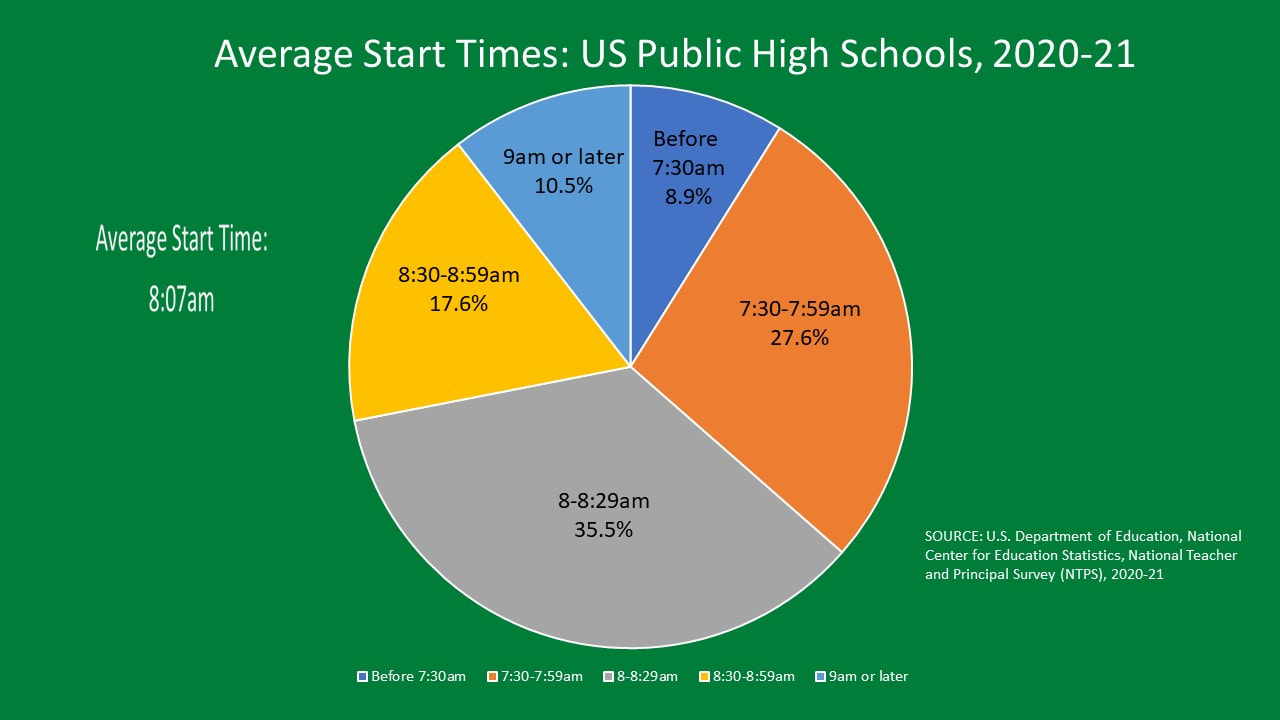
- Among public K–12 schools in 2020-21, the average start time was 8:13 a.m., with elementary schools having a later average start time by a few minutes (8:16 a.m.) than middle (8:11 a.m.), combined/other (8:08 a.m.), and secondary/high (8:07 a.m.) schools. (NCES 2020-21)
- A higher percentage of public secondary/high schools (9 percent) had start times before 7:30 a.m. compared to middle (6 percent), combined/other (3 percent), and elementary (3 percent) schools. (NCES 2020-21)
- Private K–12 schools had an average start time of 8:12 a.m., and 1 percent of private schools reported start times before 7:30 a.m. (NCES 2020-21)
- Additionally, the schools’ official start times varied by the type of instruction schools reported they were offering as a result of COVID-19 at the time they completed the questionnaire. (NCES 2020-21)
- Public schools offering only distance-learning instruction as a result of COVID-19 had a later average start time by a few minutes (8:21 a.m.) than schools offering a hybrid of in-person and distance-learning instruction (8:11 a.m.) or those schools with only in-person instruction or for which they reported COVID-19 had no effect on the instruction (8:09 a.m.).
- Among private schools, those offering only distance-learning instruction as a result of COVID-19 had a later average start time (8:24 a.m.) than did schools offering a hybrid of in-person and distance-learning instruction (8:11 a.m.) or those schools with only in-person instruction or for which they reported COVID-19 had no effect on the instruction (8:12 a.m.) (table A-5).
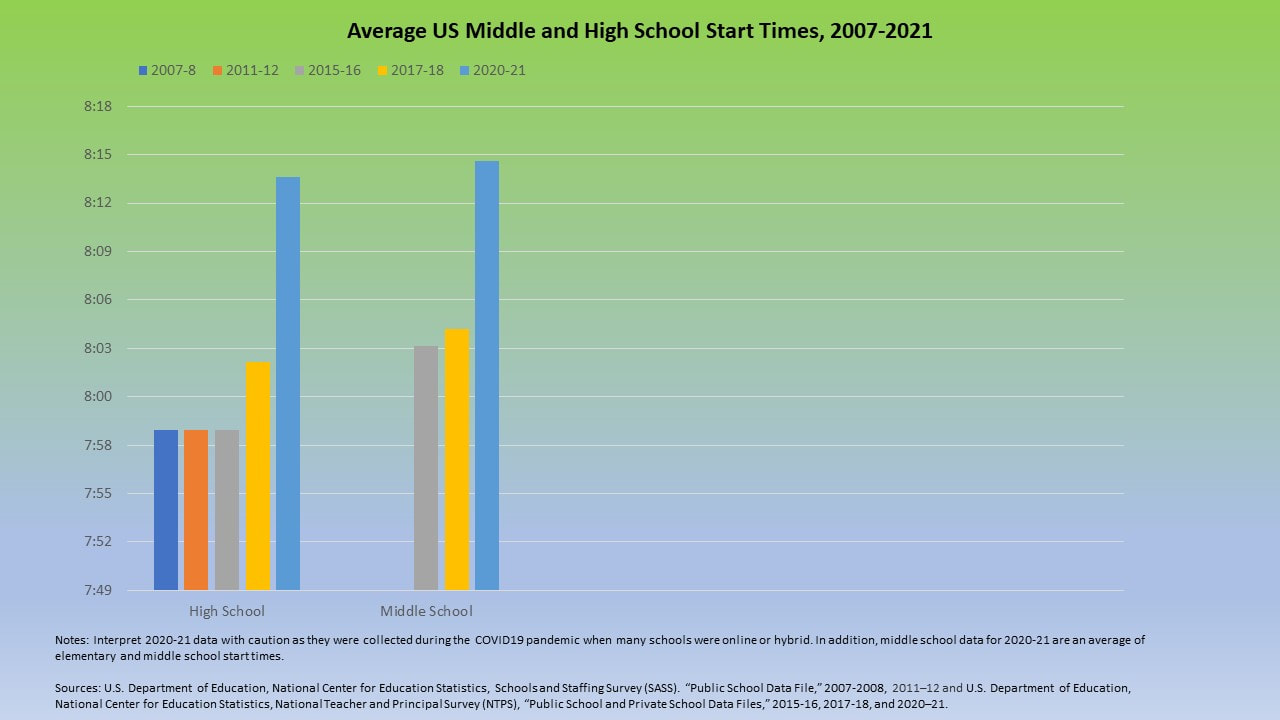
- The percentage of school districts starting high school at 8:30 a.m. or later rose 3% between 2016 and 2018, the last year that percentage was assessed. However, the percentage of high schools starting classes before 7:30 a.m. remained about the same.
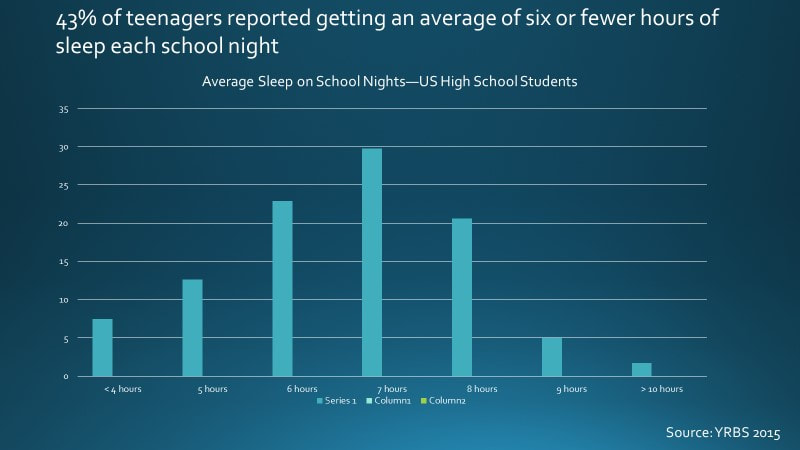
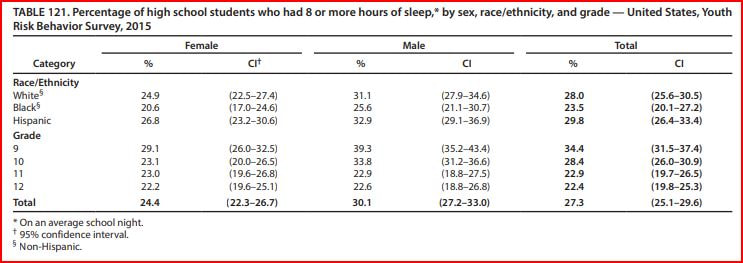
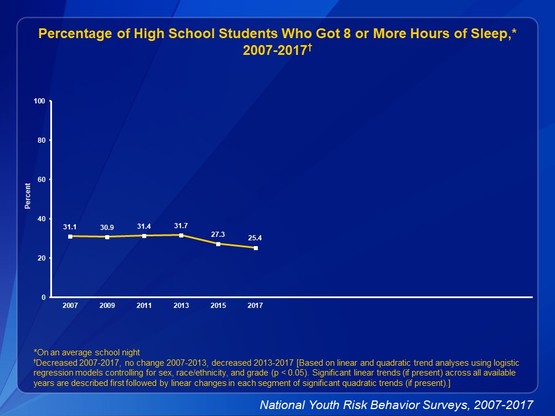
- The CDC's Youth Risk Behavior Survey in 2019 showed that 77.0% of U.S. high school students get fewer than 8 hours of sleep on school nights. This is an increase from the 2017 findings, which showed that 75.4% of U.S. high school students get fewer than 8 hours of sleep on school nights, and 43% get 6 or fewer hours. It also reflects a growing downward trend from the 2011, 2013, and 2015 surveys.
- A large majority of American high school students did not meet the CDC’s recommendation for 9-10 hours of sleep per night according to a study of four nationally representative successive samples of American high school students from 2007-2013.
- A higher percentage of public high schools in cities (26 percent) reported a starting school time of 8:30 a.m. or later than schools in suburban, town, and rural communities (18 percent, 13 percent, and 11 percent, respectively). (NCES 2017-18.)
- A higher percentage of charter schools (24 percent) reported a starting time of 8:30 a.m. or later, compared to traditional public schools (17 percent). (NCES 2017-18.)
- High schools in four states (Connecticut, Louisiana, Massachusetts, and New Hampshire) reported their average starting time as being before 7:45 a.m. (NCES 2017-18.)
- High schools in the four states of Alaska, Iowa, Minnesota, and South Carolina, and the District of Columbia reported their average starting time as being 8:16 a.m. or later. (NCES 2017-18.)
- A National Sleep Foundation poll found 59 percent of 6th through 8th graders and 87 percent of U.S. high school students were getting less than recommended hours of sleep on school nights.
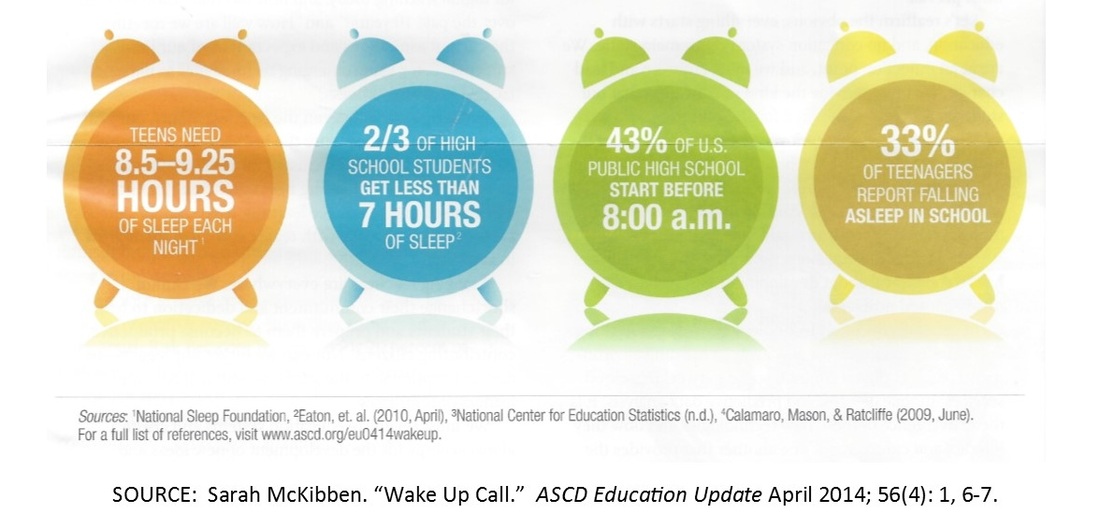
- Most middle and high school students need about 9 hours of sleep per night.
- Girls are less likely to report getting > 7 hours of sleep per night than boys, as are racial/ethnic minorities, urban students, and those of low socioeconomic status (SES). However, minority or low SES teens and families are also more likely to believe they are getting adequate sleep. (Pediatrics, Feb. 16, 2015)
- Shifts in the sleep-wake cycle at puberty mean that most adolescents get their best sleep between 11 p.m. and 8 a.m.
- The American Academy of Pediatrics, Centers for Disease Control and Prevention, and American Medical Association all recommend that middle and high schools start class no earlier than 8:30 a.m. to allow students to get healthy sleep
- More than 4 in 5 (82.3%) of U.S. middle, high, and combined public schools require students to attend class at times earlier than recommended by the American Academy of Pediatrics, Centers for Disease Control and Prevention, and American Medical Association. (Wheaton, CDC, August 7, 2015)
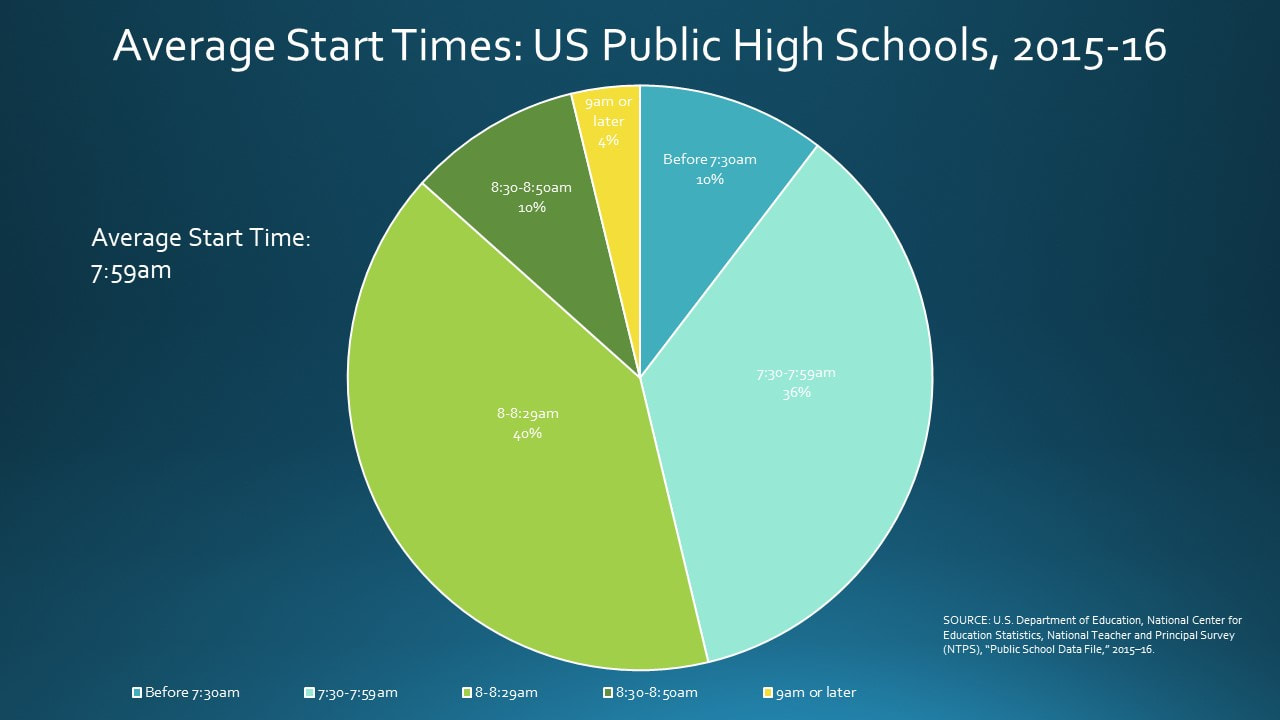
- Over 10% of U.S. high schools start the school day before 7:30 a.m., 42.5% before 8 a.m., and only 14.4% at 8:30 a.m. or later. (NCES, 2015-16)
- The average public high school in the U.S. starts at 7:59 a.m. (NCES, 2015-16 and NCES. 2011-12)
- Average high school start times in U.S. public schools got progressively earlier from 1986-2002, although not significantly so: 7:56 am in the 1986-1987 school year, 7:56 a.m. in 1991-1992, 7:55 a.m. in 1996-1997, and 7:54 a.m. in 2001-2002. (Wolfson & Carskadon, 2005)
- In the 1950 and 1960s, most In the 1950′s and 1960′s, most schools started between 8:30-9:00 (National Center for Health Research)
- Among an estimated 39,700 U.S. public middle, high, and combined schools, the average start time is 8:03 a.m. (CDC Report 2015, based on 2011-12 data).
- Over 20% of U.S. middle schools start the school day at 7:45 a.m. or earlier. (American Academy of Pediatrics).
- 20-30% of high school students and 6% of middle school students fall asleep in school each day.
- More than half of licensed teens (56%) admit to having driven when feeling too tired to drive their best, and nearly one in 10 teens report that they have completely fallen asleep at the wheel. (SADD and Liberty Mutual Study, 2016)
- Insufficient sleep in teens is associated with obesity, migraines, and immune system disruption and with health risk behaviors including smoking, drinking, stimulant abuse, physical fighting, physical inactivity, depression, and suicidal tendencies
- Sleep-deprived teens participate in more violent and property crime than other teens.
- An estimated 27% of all drowsy-driving-related car crashes involve 16-19 year old drivers. (AAA Foundation, 2018).
- When schools have delayed the start of the school day, communities have seen reduced tardiness, sleeping in class, and car crash rates, as well as improved attendance, graduation rates, and standardized test scores
- A major, multi-state study conducted by researchers at the University of Minnesota and the U.S. Centers for Disease Control and Prevention linked later high school start times to significant decreases in teen substance abuse, depression, and consumption of caffeinated drinks.
- When Jackson Hole High School in Wyoming shifted its start time to 8:55 a.m., the number of car crashes involving teenage drivers dropped by 70%
- Switching middle school start times by 30 minutes or more to after 8 a.m. in Wake County, NC was associated with increased math and reading test scores, with disadvantaged students benefiting most
- A study at the US Air Force Academy showed first-year students starting classes after 8 a.m. performed better not only in their first classes but throughout the day
- A report published by The Brookings Institution associated a significant increase in test scores with later middle and high school start times, with benefits roughly twice as great in disadvantaged students
- The Brookings report also estimated that later high school start times create a lifetime earnings gain of $17,500 per student with a school system cost of $0.00 to $1,950 per student, a benefit-to-cost ratio of 9:1 or better
- Bills to study, incentivize, or mandate healthy school start times have been introduced in at least 25 U.S. states and territories--and so far at least 10 of them have passed.
- RAND economists estimate that delaying U.S. middle and high school start times to 8:30 a.m. would contribute $8.6 billion dollars to the U.S. economy after just two years, $83 billion after a decade, and $140 billion after 15 years, with an average annual gain of $9.3, far outweighing any costs of change.
Charts and Graphs
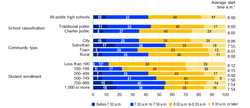 SOURCE: U.S. Department of Education, National Center for Education Statistics, National Teacher and Principal Survey (NTPS), “Public School Documentation Data File,” 2017–18.
! Interpret data with caution. The coefficient of variation (CV) for this estimate is between 30 percent and 50 percent (i.e., the standard error is at least 30 percent and less than 50 percent of the estimate).
‡ Reporting standards not met. The coefficient of variation (CV) for this estimate is 50 percent or greater (i.e., the standard error is 50 percent or more of the estimate).
1 Schools with afternoon start times were not included in the average.
‡ Reporting standards not met. The coefficient of variation (CV) for this estimate is 50 percent or greater (i.e., the standard error is 50 percent or more of the estimate).
1 Schools with afternoon start times were not included in the average.

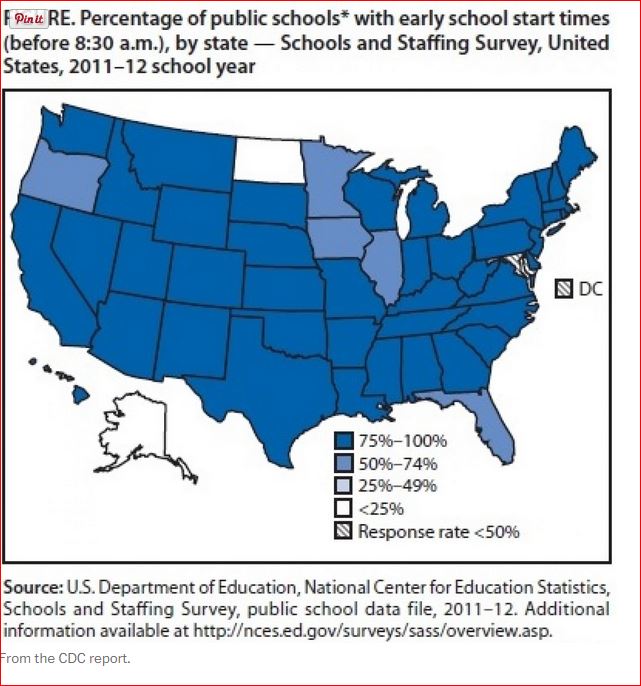
Note: Map above shows percentage of public and charter middle and high schools in each state with first bell times before 8:30 a.m.
|
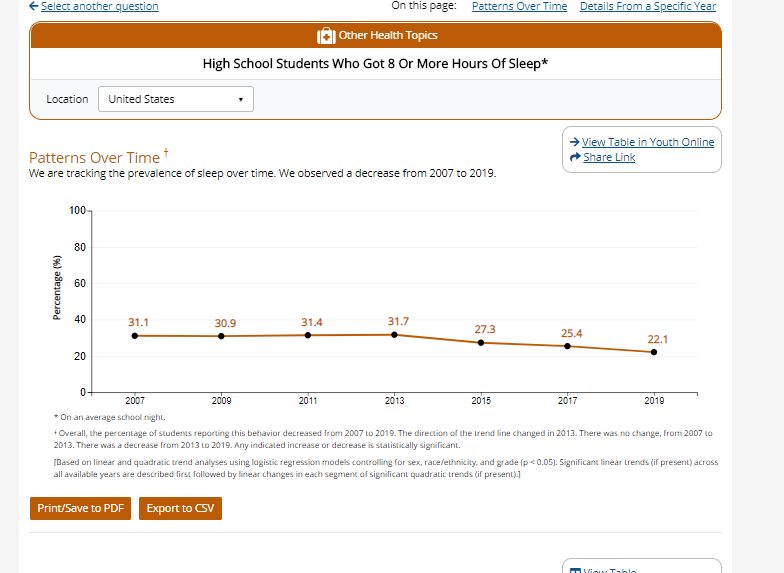
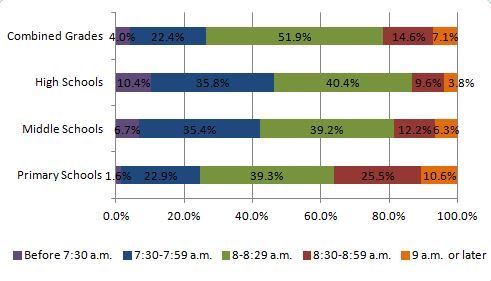
Source: Education Week, High Schoolers Still Start School Earlier Than Younger Students, Data Show, August 21, 2017
|
|
|
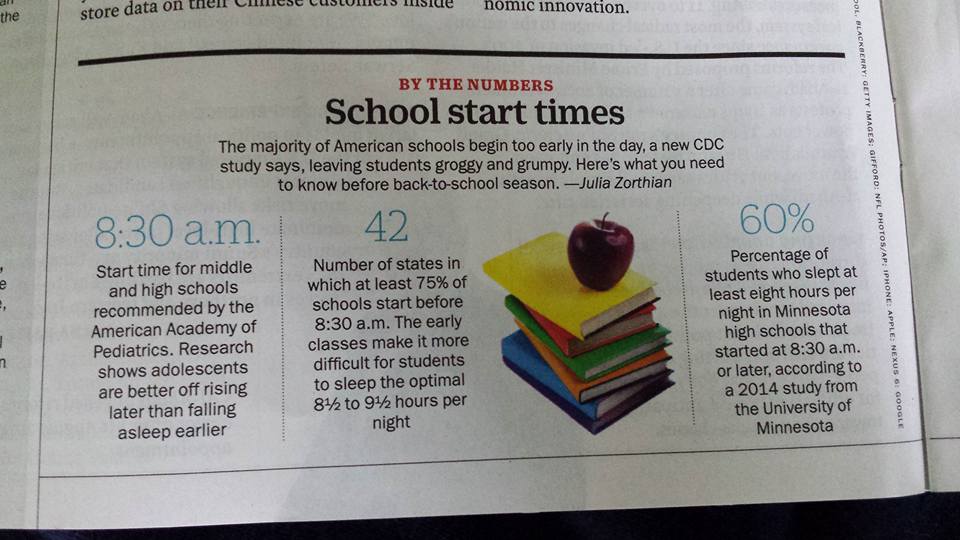
Time Magazine, August 24,2015, p. 14.
Comparative Bell Times ‐ Large Suburban Districts
Select School Districts with Later Start Times Grid (via Blueprint for Change, pp. 6-10)
Sleep Cycle Report on Teen Sleep Patterns Around the World (2014)
Select School Districts with Later Start Times Grid (via Blueprint for Change, pp. 6-10)
Sleep Cycle Report on Teen Sleep Patterns Around the World (2014)