|
By Brendan Duffy, Athletics Liaison, Start School Later 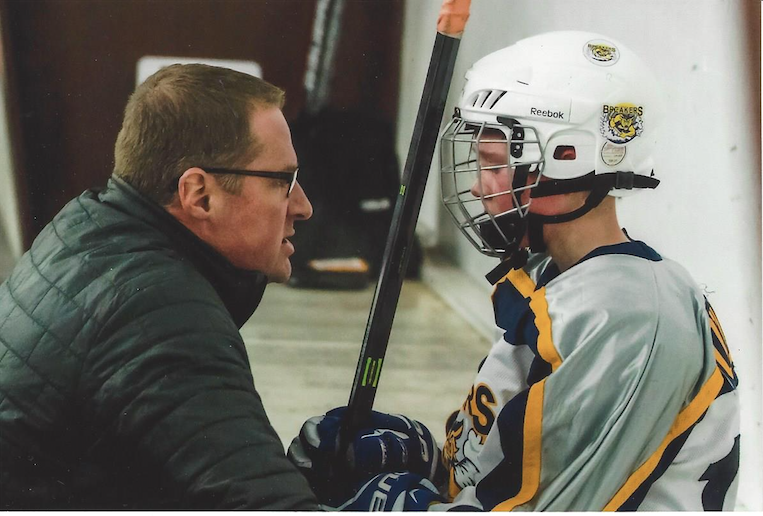 Coach Jay Pecora of Saco, Maine talks with middle school athlete Baker O'Leary As a former travel baseball coach and a father of a high school and college sports player, I had the opportunity to speak with, and listen to, many coaches over many years of time on ballfields, football fields, and basketball courts throughout the East Coast. While most coaches are dedicated to the health and safety of their teams, there is an unfortunate disconnect from what coaches say to kids about athletic achievement, safety and the inherent life lessons learned playing a sport, and the life-altering impact of early start times on their school team players. I do not fault the coaches for this disconnect, the idea of sleep being necessary and meaningful is lost on so many people. Sleep is often treated as loose change! Whatever time is left for sleep is what is devoted to sleep. This type of thinking can lead to dire consequences for a hard working athlete in training. Especially when that schedule requires an ill-fitting early rise time for school. Many coaches are great with game strategies but I hardly expect them to be experts about teenage sleep patterns and their circadian rhythms! Hopefully, as this issue gathers more coverage, they will become convinced (as many other coaches have) that sleep really is a matter of athletic success. I am certain that no coach wants to see a player harmed on the field or from falling asleep while driving. I am sure that they will pay heed to studies that show an increase in drug and alcohol use from athletes that are sleep deprived. Sleep should be treated as the foundation of an athlete’s very busy day. So let’s look at the 7 most common statements coaches emphasize to parents and players and compare them with the arguments I often hear against later school start times. By ignoring teen circadian sleep needs, these well-meaning coaches may be, unwittingly, putting their players in harm’s way. '1. “More important than the results of the game is our ability to develop healthy and successful young men and women in the game of life.” Early start times don’t allow sufficient recovery time for athletes who have worked out strenuously. This can lead to injury and poor health. According to one 2014 national study, athletes that slept less than 6 hours per night were injured at a rate of 68% above those who slept more each night! It is hard to be successful when you are “running on empty” as many of these high school players are. We know that insufficient sleep disrupts growth hormones and impairs testosterone production, yet many high school athletes are playing with lower testosterone levels that are on par with a much older player. 2. “We are teaching these kids life skills that will help them long after their playing career is over.” According to this March 2017 study from Penn State, Sleep is as important to health as diet and exercise. Neglecting to teach good sleep hygiene in this life skill equation creates bad habits that become harder to break as we get older, and lead to a myriad of chronic health problems such as diabetes, obesity, or abuse of medications. By discounting early start times, we are silently approving of sleep deprivation behaviors that lead to bad and impaired judgment. 3. “We are always looking out for the health and wellbeing of our players. We even do preseason testing and we call off practices when the weather is too hot.” We really are not doing the above if we are not championing reasonable and healthy start times for student athletes. Last year I did a review of the research. Even some of the testing being done, such as baseline concussion testing, may be inaccurate if the baseline testing is done on sleep-deprived students. Just as we monitor how heat and extreme temperature impact our players, we also need to monitor sleep and recovery every practice. 4. “We use cutting edge tools and strategies to ensure we are best prepared for our games.” Is this true when it comes to supporting an athlete’s sleep? As a coach, are you asking your players on a daily basis how much sleep they had? Professional teams (and many colleges) do this regularly and adjust their practices accordingly.Why do the professionals (and many colleges!) do this? Why do they incur the wrath of their TV sponsors and networks when they sit out their stars? Because the science is overwhelming that proper rest improves performance and recovery. In basketball, shooting percentages increase, fouls and turnovers decrease, and players are not experiencing the same injury frequency if rested. In baseball, a recent study from Stanford University showed that even one hour of extra sleep each night improved the focus and reaction time by 13 percent for baseball players who have to quickly decide whether to swing at a pitch or not. 5. “We don’t want to hurt a player so we are fully behind the implementation of anything that helps the player: such as a pitch count and proper rest between pitching.” As important as the above thought process is, if coaches truly want to protect not only a pitcher’s arm, but also their entire mental and physical well being, they should get behind a start school later effort. Adequate sleep affords a level of protection and recovery far above just looking out for a sore arm or a “dead arm” period. We also should explain what proper rest means to players. Many colleges are left with this task as their high school coaches never addressed sleep as an important and necessary element of athletics and time management. One college program that addresses sleep with their athletes is the University of St. Thomas. In a recent blog on their website about their sleep program for athletes it was mentioned that “when the coaches –see how many detailed and specific questions the players have about sleep, and they see how far off their own thinking has been about sleep, it’s pretty interesting.” Sleep is now a common lecture on college sports campuses and players who devote over 50 hours to their sport each week are definitely appreciative of any suggestions to protect their minds and bodies from the rigors of sports and academic. Fortunately for college athletes, they often get to select their own class schedules so they can get some additional recovery time. 6. “Playing sports is a great vehicle for keeping kids off the streets and from the lure of drugs and alcohol.” Yes, but not if we don’t focus on sleep. Sleep deprivation leads many athletes to self-medicate with sleep aids and fatigue can lead to poor judgment and increased drug and alcohol usage. A recent preliminary study presented at the American Academy of Sleep Medicine sleep conference in Boston indicates that sleep disturbances can predict substance abuse among college athletes. The results show that student athletes who haven’t worked out sleep issues were 151 percent more likely to use cigarettes, 36 percent more likely to use alcohol, and 66 percent more likely to smoke marijuana. 7. “As a coach, I need to look at the situation and put my players in the best possible position to succeed.” I hope after reading this blog coaches are at least open to the idea of exploring how starting school later can make for a better player. Sleep is a controllable advantage that puts players not only in a position to win the games on the field, but to be winners as they move on to college and beyond. Long after the scores are forgotten, and the trophies are boxed, there will be athletes that think of how truly cutting edge their coach was and how he or she was willing to work through the obstacles to help them become healthy, productive, and successful citizens. Let’s put true meaning to the words we speak and let’s see what we can do together to beat the logistical opponents that stand in the way of our teams success. Many have already made the switch and are happy with the results. Some have even gone on to win championships after school start time changes that allowed players more sleep and recovery. Sleep Well--Compete Best!
|
 RSS Feed