|
by Terra Ziporyn, PhD One of the first questions people ask about school start times is deceptively simple: How many districts have moved to healthier hours? It sounds like the kind of thing we should be able to answer with a clean number, a neat chart, or a tidy national map. But we can’t — and the reasons why say a lot about how education works in this country. There is no national database. No federal reporting requirement. No consistent state‑level tracking. Districts can change schedules quietly, sometimes partially, sometimes temporarily, and sometimes only for certain schools or grades. Some shift by ten minutes, others by an hour, and many don’t announce the change in any way that’s searchable. Even when we know a district has changed, it’s often unclear when, how, or for whom. And because the U.S. has nearly 14,000 school districts—each with its own calendar, politics, and communication habits—the picture is always incomplete. What we have instead is a patchwork: media reports, advocacy updates, scattered state data, and the stories families and educators share with us directly. Enough to see the momentum, but never enough to produce the simple number everyone wants. The absence of a clean tally doesn’t mean the movement is small or that there aren't other excellent ways to assess it. It means the system isn’t built to track change of this kind—even when that change is widespread, accelerating, and deeply consequential for kids’ health and safety. In the full piece, I explain why the question has no straightforward answer, what we can say with confidence, and what this lack of data reveals about the broader landscape: Read the Full Article at https://terraziporyn.substack.com/p/how-many-schools-have-moved-start Terra Ziporyn is Start School Later's Executive Director and Co-Founder
by Terra Ziporyn, PhD For decades we’ve known that early school start times are fundamentally misaligned with adolescent biology. Teens aren’t choosing to be tired—their circadian rhythms shift naturally during puberty, making it nearly impossible for them to fall asleep early enough to function at a 7:00 a.m. bell. Yet most middle and high schoolers in this country are still expected to operate at hours that would be considered unsafe and unacceptable in almost any other setting. Starting school later isn’t about indulgence, convenience, or giving teenagers “what they want.” It’s about giving them what many major medical organizations say they need: enough sleep to support healthy brain development, emotion regulation, learning, and basic physical safety. Districts that have made the shift consistently see the same results: better attendance, higher graduation rates, improved mental health, fewer car crashes, less substance misuse, stronger classroom engagement, and calmer, more focused classrooms. The research is overwhelming, but what’s equally striking is how quickly communities adapt once the change is made. The fears—about sports, buses, childcare, after‑school jobs—rarely materialize the way people imagine. In fact, many of the predicted obstacles shrink or disappear once communities decide alighing schedules with biology rather than tradition is a top priority. The real barrier isn’t evidence. It’s inertia. We’ve normalized a system that asks teenagers to perform at their cognitive low point and then blames them when they struggle. We can do better — and the path forward is clear. I walk through the science, the lived experience, and the practical realities in the full piece: https://terraziporyn.substack.com/p/the-case-for-starting-school-later Terra Ziporyn is Start School Later's Executive Director and Co-Founder
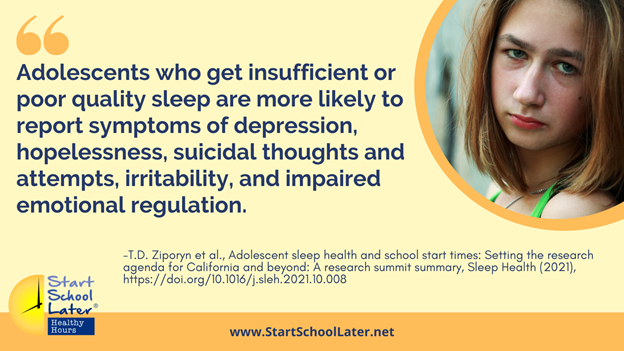
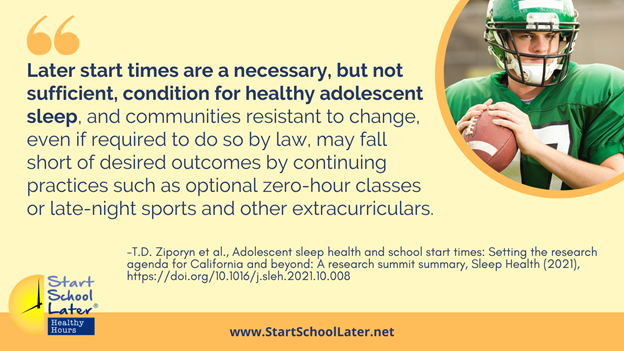
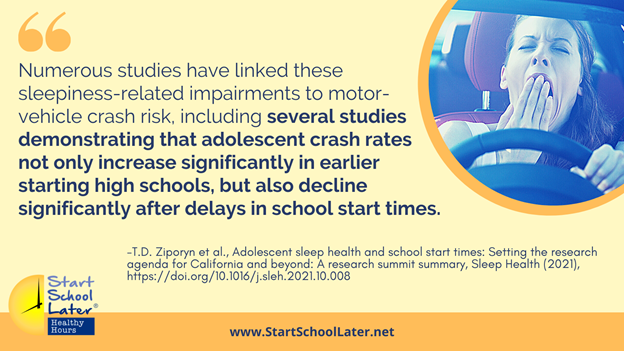
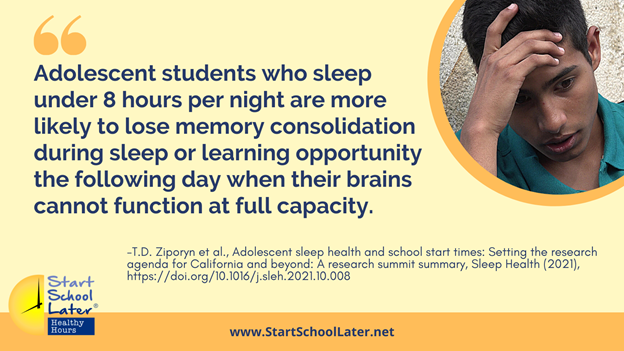
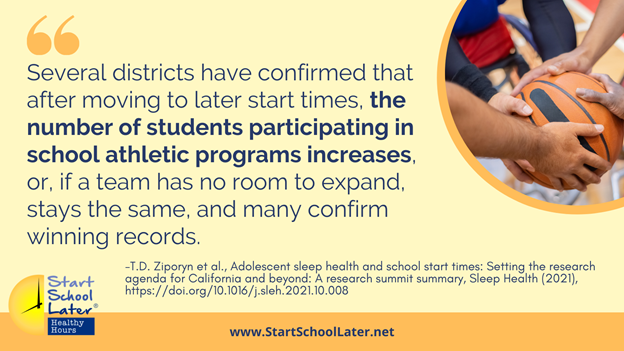
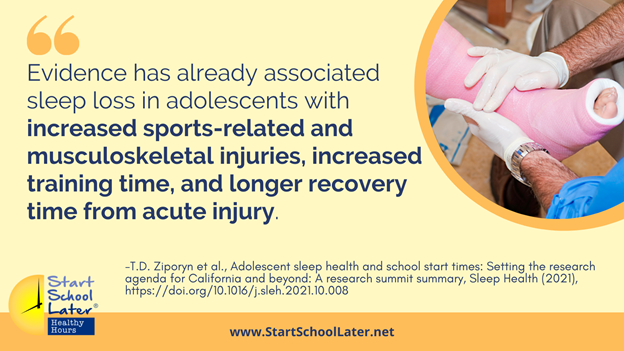
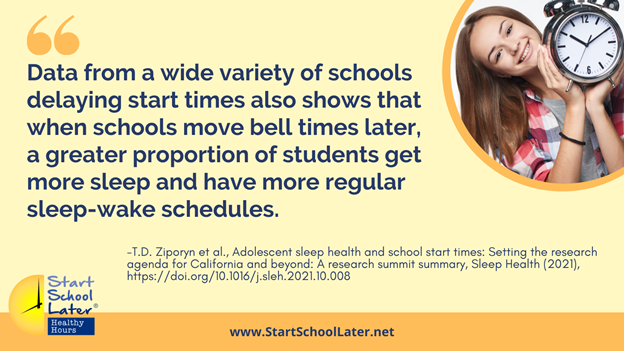
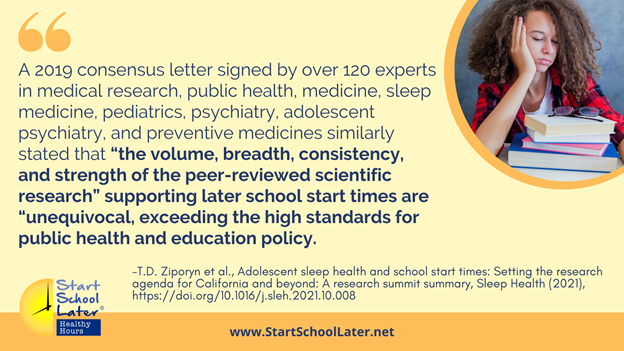
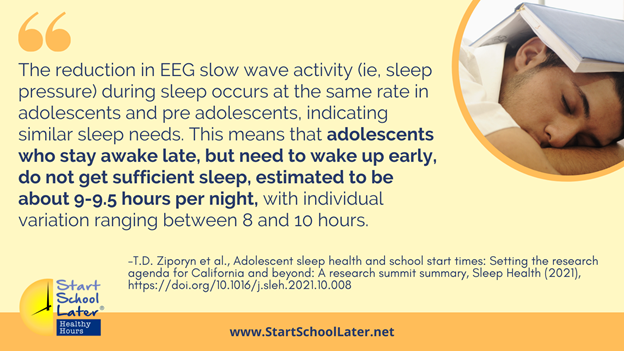
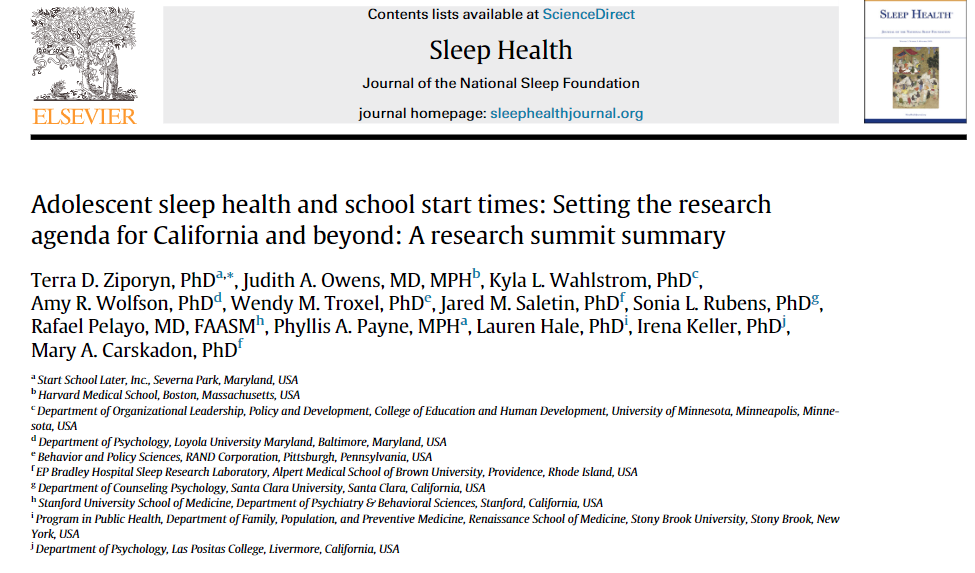
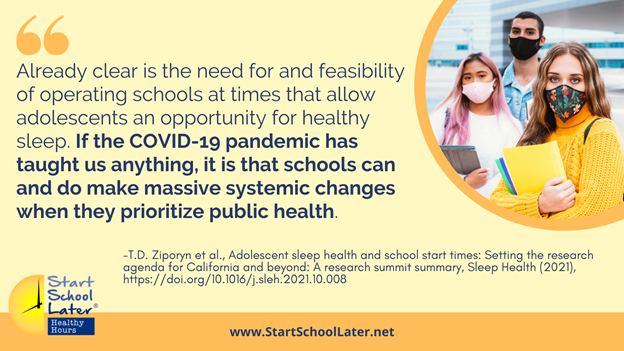
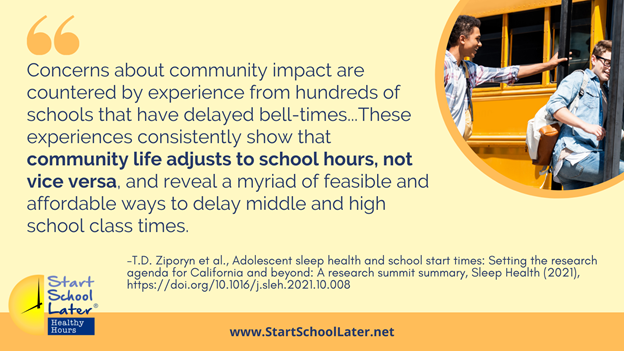
An up-to-date, peer-reviewed summary of the research on teen sleep and school start times--plus expert recommendations about ways to build on that research and turn it into school policy. By Elinore Boeke We’re excited to share a newly-published summary of last year’s Summit on Adolescent Sleep and School Start Times: Setting the Research Agenda for California and Beyond. The Summit was spearheaded by Start School Later/Healthy Hours, and hosted by the Department of Psychiatry and Behavioral Medicine at the Stanford University School of Medicine with support from the National Sleep Foundation and American Academy of Sleep Medicine. The peer-reviewed summary is now available online, and will be included in the February 2022 print edition of the Sleep Health Journal, published by the National Sleep Foundation. Using an extensive body of multidisciplinary research, the Summit established once and for all that most US schools should—and can—start later in the morning. It also identified ways future research questions might help turn this research into school policy — including ways to build community support for and awareness of healthy sleep while reducing disparities. PLEASE WIDELY SHARE THIS TERRIFIC SUMMARY OF THE EVIDENCE SUPPORTING HEALTHY SCHOOL START TIMES! We’ve created the shareable graphics you see in this blog with quotes from the paper for your use. (If we missed a useful quote, or if you need a different size, please reach out to Elinore Boeke, SSL communication director, at [email protected]. BACKGROUND The impetus for the Summit was California’s SB328. Passed and signed into law in 2019, this is the first U.S. statewide legislation ("healthy school start time" law) explicitly designed to protect adolescent sleep health by requiring most California public school districts to start no earlier than 8:00 a.m. for middle schools and 8:30 a.m. for high schools. The bill was co-sponsored by Start School Later and the California State PTA. California schools must implement the new law in place by July 1, 2022, or by the expiration date of any district or charter school’s bargaining agreement in effect on Jan. 1, 2020 Recognizing the unique opportunity presented by the the groundbreaking new law’s three-year implementation period, Start School Later brought together participants from a wide-range of academic backgrounds who organized a virtual summit to review current knowledge on adolescent sleep health and school start times and provide key research recommendations. The summit’s conclusions support the National Sleep Foundation’s new position statement recommending that middle and high schools start no earlier than 8:30 a.m. and calling on the federal government to provide and fund evidence-based resources and monitoring to help school communities delay bell times and reduce sleep health disparities associated with school start times. Terra Ziporyn, PhD (aka Terra Ziporyn Snider), Executive Director and Co-Founder of Start School Later, is the lead author of the paper. Other members of the Start School Later Board of Directors, Advisory Board, and National Team are also authors on the paper: Judith Owens, MD; Amy Wolfson, PhD; Rafael Pelayo, MD; and Phyllis Payne, MPH. We encourage you to share this paper with school leadership, elected officials, community leaders, and others with an interest in improving student outcomes. MORE SHAREABLE IMAGES
|
RSS Feed